Anydesk for Mac 10.10 Download Updated
Anydesk for Mac 10.10 Download
Table of Contents
The AnyDesk remote desktop for macOS brings you seamless connectivity and a uncomplicated setup. Using custom clients, information technology tin can be individually tailored to your specific operations.
System Requirements
AnyDesk for macOS is supported on macOS 10.11 and newer.
MacOS 11.0 Big Sur and newer equally well equally Apple Silicon devices are only supported on AnyDesk for macOS half dozen.1.0 and later.
Legacy clients for macOS 10.10 can be found hither but are no longer supported.
Installation & Uninstallation
Installation
MeetInstallation – Operating-System-Specific Instructions – macOS.
To gear up the required security permissions to receive incoming sessions, please see Security Permissions on macOS.
Uninstallation
To uninstall the portable version of AnyDesk for macOS:
- Move AnyDesk from the "Applications" folder to Trash
- Delete the~/.anydesk/and/etc/anydesk/ folders for standard AnyDesk clients
- Delete the~/.anydesk-ad_<prefix>/ and/etc/anydesk-ad_<prefix>/ folders for custom AnyDesk clients
To uninstall the installed version of AnyDesk for macOS:
- Go to Menu > About AnyDesk
- Hold the option/ALT key
- Click "Uninstall" on the top right corner of the window
- Delete the~/.anydesk/and/etc/anydesk/ folders for standard AnyDesk clients
- Delete the~/.anydesk-ad_<prefix>/ and/etc/anydesk-ad_<prefix>/ folders for custom AnyDesk clients
Warning: Please note that deleting the above folders will permanently delete the AnyDesk-ID and Alias registered to that AnyDesk client and cannot be restored unless a backup has been made. Please seeAnyDesk-ID and Alias.
Security Permissions
Delight see Security Permissions for macOS.
Notarization
By default, custom clients are non signed by Apple tree. This means that users starting up the custom client may get a warning prompt and stop them from starting the AnyDesk client. One workaround for this is to simply correct-click the custom AnyDesk application and select "Run".
Alternatively, if yous practise not wish to see the alarm prompt, you can enable "Notarize Client" in the custom client configurator. This would send your macOS custom customer to Apple servers to be notarized after it has been saved.
Notation:
The time required to notarize the macOS custom customer is highly dependent on the electric current load on Apple notarization servers. This means the fourth dimension required for notarization tin take anywhere from 15 minutes to 6 hours.
If the notarization of the client takes more than than 6 hours, we would highly recommend making a copy of the custom customer configuration and notarizing that instead.
Please note that saving whatsoever changes to the custom client configuration or a new AnyDesk version for macOS volition restart the notarization procedure.
Have Window
The Take Window is displayed when a connection request is fabricated to the AnyDesk client unless "Always show incoming session requests" has been disabled in Settings > Security > Interactive Access.
This window is always shown when there is an active session.
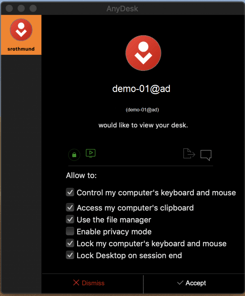
From this window, the user can:
- Accept or reject the connection request or disconnect the currently connected session
- Come across the AnyDesk-ID/Alias that is requesting the connection or is connected
- Encounter the encryption and connection blazon
- Access files copied from the connecting customer if "Synchronize clipboard" is agile
- Admission chat with the connecting client
- Prepare the permissions of the connecting client
- Disabling all options in Settings or in the Accept Window results in a view-merely session.
File Director
To start a session in File Manager-merely mode, enter the AnyDesk-ID/Allonym of the remote device and click "Browse files".
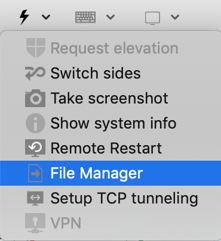
While in a session, the File Director can also be accessed using the Files icon in theAnyDesk toolbar.
Notation: Network drives and UNC paths are currently non supported.
File Transfer
SeeFile Manager and File Transfer.
Cross-platform Shortcuts
Due to the divergence in functionality between macOS, Windows, and Linux Super Keys, it is not possible to directly translate operating-system-specific keyboard shortcuts.
When using a macOS device to command a Windows/Linux device or vice versa, delight apply the shortcuts of the device being controlled:
| macOS | Windows/Linux |
|---|---|
| control (CMD) | WIN / SUP |
| selection | ALT |
| control | CTRL |
Examples
Re-create & paste from Windows/Linux to macOS:
- re-create with CTRL+C on the local Windows/Linux device,
- paste with WIN/SUP+Five
Copy & paste from macOS to Windows/Linux:
- copy with CMD+C,
- paste with command+5
Accessing macOS Spotlight from Windows/Linux
- CMD+Space (apply WIN/SUP in place of the control key)
Settings
Other than the standardsettings found across all AnyDesk platforms, macOS users have the following unique options in the "User Interface" tab:
Transmit keyboard shortcuts: Enabling this option will let the user of the macOS client to transmit keyboard shortcuts to the remote customer.
Have all remote keyboard shortcuts: Enabling this option will enable access to the additional keyboard shortcuts defined in the macOS "Organization Preferences" > "Keyboard" > "Shortcuts" settings. Delight notation that additional permissions will demand to be accustomed on the macOS device once this option has been enabled.
Use Right Command as a Host Key:With this option enabled, just the left Control key is transmitted to the remote device. The right Control cardinal will then be available for controlling the local macOS device.
Sound
Audio manual is not currently bachelor for AnyDesk for macOS due to vendor limitations.
Address Volume
Please meet Address Book.
Anydesk for Mac 10.10 Download
Posted by: taylorsimand.blogspot.com

